Retreat Pre-Reflection: Our Small Planet
by Khalid Y. Long, Howard University
Elinor Fuchs’s “EF’s Visit to a Small Planet” is one of the most useful tools for dramaturgs. Fuchs asks us to take a beat and breathe before jumping into analysis mode. She challenges us to observe the world placed before us. Even more, she requires that we take in its air, feel its water, bask in its sun, and listen to the wind blowing through the trees. It’s an invitation to suspend our disbelief and live – genuinely – in the world that the writer has crafted. We are prompted to decelerate and allow the world of the play to emerge according to its own logic.
“EF’s Visit to a Small Planet” is a ripe framework for considering the next 40 years of LMDA, especially because its methodology is deeply connected to dramaturgical practice itself. That is, the practice of questioning. The history of dramaturgy in the theatre of the Americas has always been shaped by questions of function, value, and visibility. Dramaturgs have often worked in support roles that require careful listening, contextual thinking, and the ability to recognize relationships among artists, institutions, audiences, and culture. While the work is frequently invisible, it has repeatedly proved essential. Now it is time to convene and ask ourselves questions. As such, LMDA serves as our very own “small planet,” and it is a necessary moment for us to take a beat, breathe, and consider what the future holds—for us, for the field.
LMDA’s 40-year legacy prepares us for this new era by demonstrating dramaturgy’s capacity to work both within and beyond formal institutions, shaping public discourse and challenging the foundations of cultural and historical understanding. In this way, dramaturgs are poised to question established frameworks (and question them again), with the potential to expand who we are and what we do. In doing so, we become buoyed by the act of reframing, or perhaps reimagining, the identity of dramaturgs and by expanding the possibilities of dramaturgical practice. And for some of us, à la Sydné Mahone, Faedra Chatard Carpenter, and Otis Ramsey Zöe, it may even be a time to query the positionality of the dramaturg within contemporary cultural discourse.
During the 2026 LMDA Retreat, dramaturgs are being asked to re-engage and reflect on their connections to the profession through various prisms, including artistic practice, educational institutions, and theoretical and philosophical frameworks that continually re-imagine the landscape of dramaturgy. The Retreat, nonetheless, will prompt more questions that ask us to consider, in the way of Fuchs, how we are observing the world(s) that have shaped our system and, essentially, shaped us. Thus, the goal is not to arrive at definitive conclusions, but to sustain a practice of inquiry that opens further lines of questioning we can take back to our institutions, our playwrights, our choreographers, our directors, and our audiences.
If LMDA’s 2026 Retreat is our “small planet,” then, as Fuchs instructs, it is time to “construct meaning in this world in many different ways.” Most importantly, “construct it in the most inclusive way you can.”
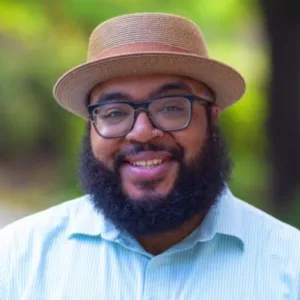
Khalid Y. Long, PhD, is the Associate Dean of Research and Creative Endeavors in the Chadwick A. Boseman College of Fine Arts at Howard University, where he also serves as the Interim Chair and Associate Professor of Theatre Arts.
Long’s books include Contemporary Black Theatre and Performance: Acts of Rebellion, Activism, and Solidarity (Methuen Drama) and August Wilson in Context (Cambridge University Press). A freelance dramaturg, Long has collaborated with numerous theatres nationwide, partnering with a wide array of theatre artists.