Drawn to Nature: On Dramaturgical Landscapes
by Ally Varitek
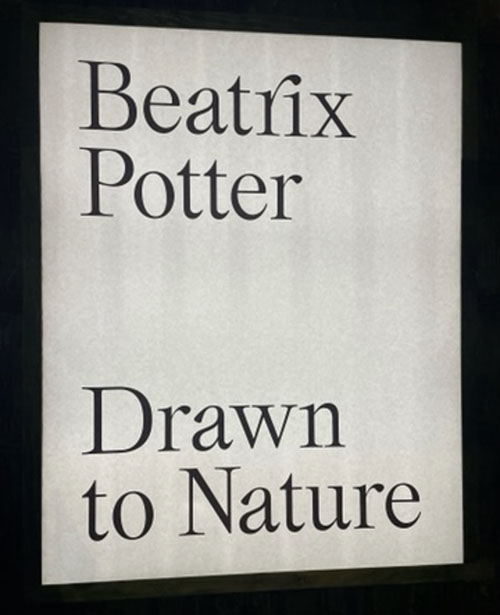 I think Beatrix Potter was dramaturgical.
The Beatrix Potter to whom I refer is the British writer, illustrator, natural scientist, and conservationist: a
multi-hyphenate, like so many of us who work within the landscape of dramaturgy.
Perhaps this sentiment is at the forefront of my mind because Potter features heavily in my own dramaturgical
landscape… at least, the literal corner of my room from where I do dramaturgy. This corner has become a
dramaturgical landscape of its own.
I have adopted a habit over the past two years of collecting that resulted in this corner. Actually, I’ve always
been a collector, from when I was a toddler, where I would stick neat-looking rocks into my pockets, only to
forget they were there and leave them for my patient mother to discover after an awful noise would ring through
the house upon the start of the washer and dryer. Those collecting quirks, unbeknownst to me, were the first
signs that I was a dramaturg. Back to Beatrix…
Over the past two years, I’ve adopted a habit of collecting visual reminders of art and words that inspire me.
Plastered across my wall is a conglomeration of postcards of art that I’ve loved at museums, quotes from
wordsmiths scrawled on scraps of paper, newspaper articles, and show programs from performances that still
resonate with me. In the left corner on the lower side of one of my walls lies a watercolor done by Beatrix
Potter. And looking down from the top right corner, the conservationist herself taking her beloved rabbit for a
walk.
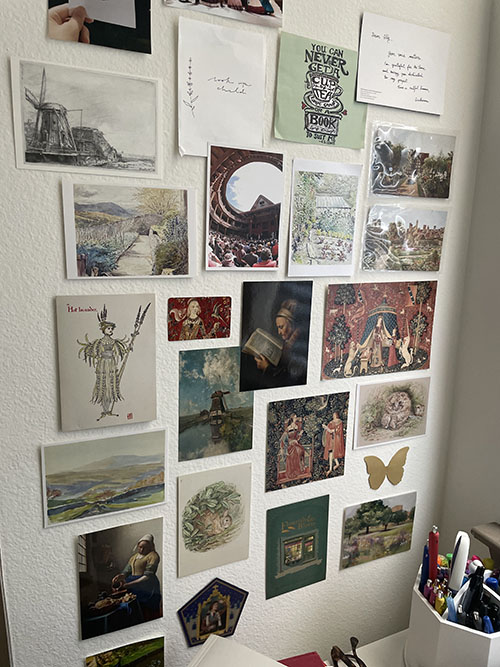 I collected these reminders of Beatrix Potter
after seeing her Drawn to Nature exhibit at the Victoria and Albert Museum in London last summer. I’d
always known her for the cute animal narratives of my childhood, but the story outside of her writing captivated
me most of all. This collection barely focused on the beloved characters of Peter Rabbit and Jemima Duck.
Instead, an entire room was devoted to her childhood love of science and various species. Potter grew up
frequently visiting Scotland and the Lake District, and over the years she curated and documented the landscapes
she so loved. Be it watercolor paintings or intricate scientific drawings of specimens, she was enraptured with
these landscapes, from the widest meadow to the tiniest fungi. I would even argue that the thumbprints of her
childhood love of landscapes are seen in all aspects of her work, from the scientific drawings to the Tale
of Peter Rabbit. She, like the young Ally with neat-looking rocks, expressed a curatorial curiosity for
the smallest of things.
It is the awareness Potter’s environment, of the necessary parts that make our landscapes possible and beautiful
and real, that is dramaturgical to me. I think all dramaturgs hold this trait of a “curatorial consciousness.”
Perhaps it begins as an affinity for curating or collecting—be it mushrooms, rocks or songs we love to hear— but
I think the mark of the dramaturg is how that consciousness grows in response to their natural
environment.
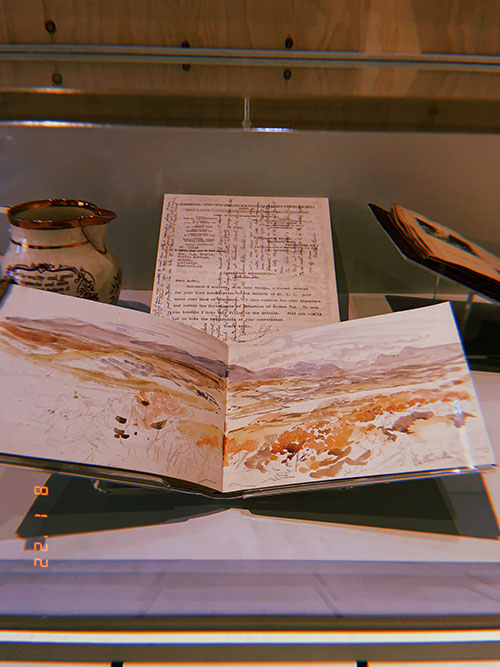 The latter end of the Drawn to Nature
exhibit featured the less-documented final chapters of Potter’s life. Having made a comfortable living with the
Peter Rabbit books, Potter was able to return to her beloved Lake District, where she purchased her own farm to
once again be immersed in Lake District’s landscapes. While there, her consciousness for the landscape led
Beatrix to notice a sharp decline in the Herdwick sheep population. Her attention to detail, this keen interest
in conservation, and the desire to keep the landscape around her healthy, prompted Potter to take matters into her own
hands. By her own efforts, she nursed and bred the Herdwick sheep population back to health.
Potter had a curatorial consciousness to recognize that this one species was integral to the living ecosystem of
the land she so loved, but she also acted dramaturgically when this consciousness led her to an actionable
empathy. She, quite literally, became a shepherd of the landscape she so loved.
As dramaturgs, our role as shepherds of stories relies on both a curatorial consciousness and the power and
willingness to do something about it. As dramaturgs, our empathy must be actionable for these stories
to grow, heal, reach, and resonate.
What does this mean for us? I think it means we can take hints from Potter’s notebooks. I think it means we
can pay minute detail to the minutiae. We should keep reminders of the landscapes we want to
work in: equitable, empathetic, connectable, challenging, and at times raw. We should familiarize ourselves with
how each seed of a story needs different conditions to grow or reach its roots and its sunlight and its
admirers. We should be humbled by the beauty in that diversity. Every soil, every landscape needs diversity, but
it also needs keen attention to its intricacies. It’s beautiful that we all resonate with different kinds of
stories and themes as dramaturgs. Our community, our landscape is robust and flourishes because of these
differences. I think, like Beatrix Potter, we should use this consciousness to create, document, and curate the
stories we know and love as well as the ones we need. It also means we must be aware enough to recognize when a
story may need the guidance of a shepherd. We must be willing to be actionable in conserving the place of plays
in our ecosystem.
I look up to Beatrix Potter, humbly fostering a curatorial consciousness and actionable empathy toward the
stewardship of the landscapes we live, grow, and die in. I hope she knew she was dramaturgical, too.