Literary Managers and Dramaturgs of the Americas was founded in 1985 as the volunteer membership organization for the professions of literary management and dramaturgy. LMDA is a not-for-profit tax-exempt organization with members throughout North America and abroad.
LMDA holds the belief that theater is a vital art form that has the power to nourish, educate, and transform individuals and their communities and that dramaturgy is central to the process of theater-making.
LMDA is committed to the following objectives:
to affirm, support, and broaden the roles that literary managers and dramaturgs play in the theater
to promote the exchange of information about the function, practice, and value of literary management and dramaturgy
to encourage cooperation among the practitioners and theoreticians of dramaturgy
to expand the boundaries of the field and enrich our conversation about the making of live performance by welcoming colleagues from disciplines such as dance, opera, and performance art
to put emphasis on international exchange, as well as a commitment to diversity of form, culture, and content
to encourage regional activity across North America
JEDIL/T STATEMENT
LMDA promotes the creation of stories that reflect a broad spectrum of authentic experiences in our diverse global community. We uphold equity, diversity, and inclusion as our foundational values, and we recognize and examine the intersectionality of our society. We are committed to provoking, addressing, and advocating for issues of justice, equity, diversity, inclusion and land/territory. Our membership is dedicated to fostering an environment of respect, celebrating difference, and seeing the principles above reflected in all aspects of our organization.
Please consider joining LMDA and adding your voice to these conversations.
Our History
1984
The year was 1984. In January, Apple introduced its Macintosh personal computer. In October, Bishop Desmond Tutu’s Nobel Peace Prize was announced. In November, “Band-Aid” recorded its first charitable hit. In December, Cynthia Jenner, Alexis Greene, and Thomas Dunn laid the framework for a not-for-profit theatre organization in a letter to the Jerome Foundation. Along with a host of colleagues, they envisioned a dramaturgy and literary management support program, soon to be incorporated, that would include in its mission publishing a quarterly newsletter; providing a computerized information bank (including a dramaturgy bibliography and a list of academic programs and courses to support the field); establishing an intern program; and creating a committee to begin a series of conferences. Prior to that document’s generation and submission, as former LMDA President David Copelin has noted, “dramaturgs in the New York-New Jersey-Connecticut area had been meeting informally once a month, usually for lunch. . . . We often spoke (sighed, actually), about creating a national, formal organization of ‘turgs.”
1985
New Dramatists generously donated office space and the use of its New York City facilities. On March 26th, 1985, LMDA was incorporated with directors Thomas G. Dunn, Susan Gregg, and Bonnie Marranca officially at the helm. That November, a national conference was sponsored by the newly formed LMDA and collaborators at Hunter College, assisted by a grant from the Arthur Foundation. (Notably, this first $1,000 grant was not awarded to a dramaturg but to playwright Sheldon Rosen, who authored a short play for a workshop at the conference.) Des McAnuff gave the keynote address, which was published in American Theatre and what was then called the LMDA Newsletter (1.1, January 1986).
1986
In August of 1986, the first “official annual” LMDA conference was held at New Dramatists, an organization that would continue to be a much appreciated friend. That year the second issue of Yale Theater to be devoted to dramaturgy was edited by member Mark Bly. (The first was edited by Joel Schechter in 1978.)
1988
In 1988, Michael Devine and DD Kugler became the first Canadian members of LMDA, and Kugler would later become the first Canadian officer (Vice-President, Communication and later LMDA President). LMDA Canada (established 1997), under the long-term leadership of Brian Quirt (later LMDA President) and currently Vicki Stroich (also 2010 Conference Chair), has achieved the distinct status of existing as both a strong national unit and a vital and integral partner in the umbrella organization Literary Managers and Dramaturgs of the Americas.
LMDA in the late 1980s was fueled by the passions of many people who worked collectively to move the organization forward through organizational leadership and conference hosting: Alexis Greene, Cynthia Jenner, David Copelin, Rick Davis, Steven Hart, Lynn M. Thomson, Mark Bly, Morgan Jenness, Susan Jonas, and a host of others.
The third annual conference, in June of 1988, was titled “Dramaturgy and the Creative Process” and was held at the O’Neill Theater Center in Waterford, Connecticut. Joe Chaikin gave a reading of his play Struck Dumb, co-authored with Jean-Claude van Itallie and commissioned by the Mark Taper Forum. At this conference, James Leverett was given an award for “Excellence in Dramaturgy.” Here is Leverett writing in the mid-80s in an article entitled “After the Revolution.”
Theatre can less and less afford to look like film and television, though it may always make creative use of them, along with everything else the world has to offer. It must, instead, look like exactly what it is: a finite space for infinite imagination.
The following year, LMDA hosted its first conference on the West coast. It was held at San Francisco State University with keynote speaker Anne Bogart, who spoke about connections among theatre, film, and television.
1990
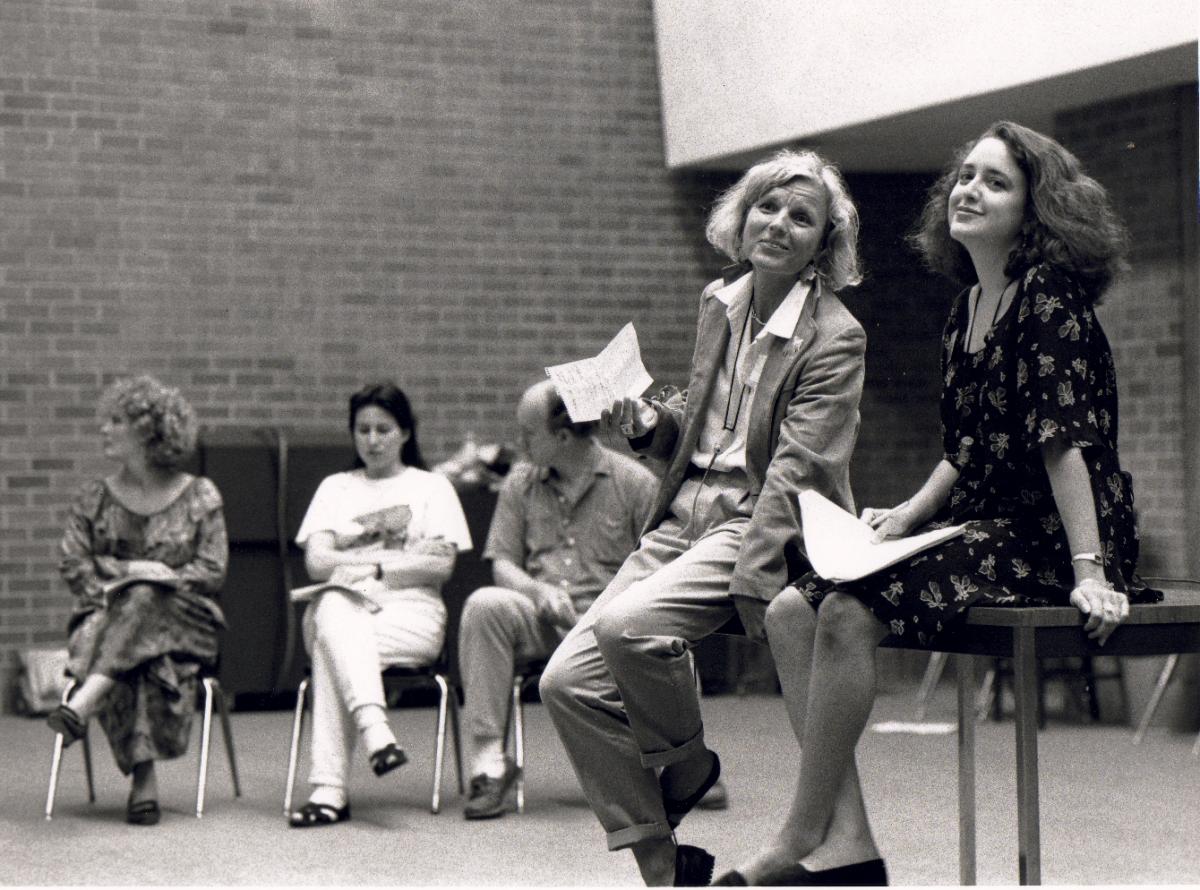
The early 1990s brought about a rush of activity for LMDA under the leadership of Anne Cattaneo, Victoria Abrash, Mark Bly, Jim Lewis, and others. In the summer of 1990, Richard Pettengill chaired a conference held in Chicago at DePaul University. At this conference, the name of the organization was changed to Literary Managers & Dramaturgs of the Americas. LMDA established a job line and hired Chiori Miyagawa as administrator, the first of several remarkable individuals to take on this position, to assist with memberships, conferences, and publications. Bravo!
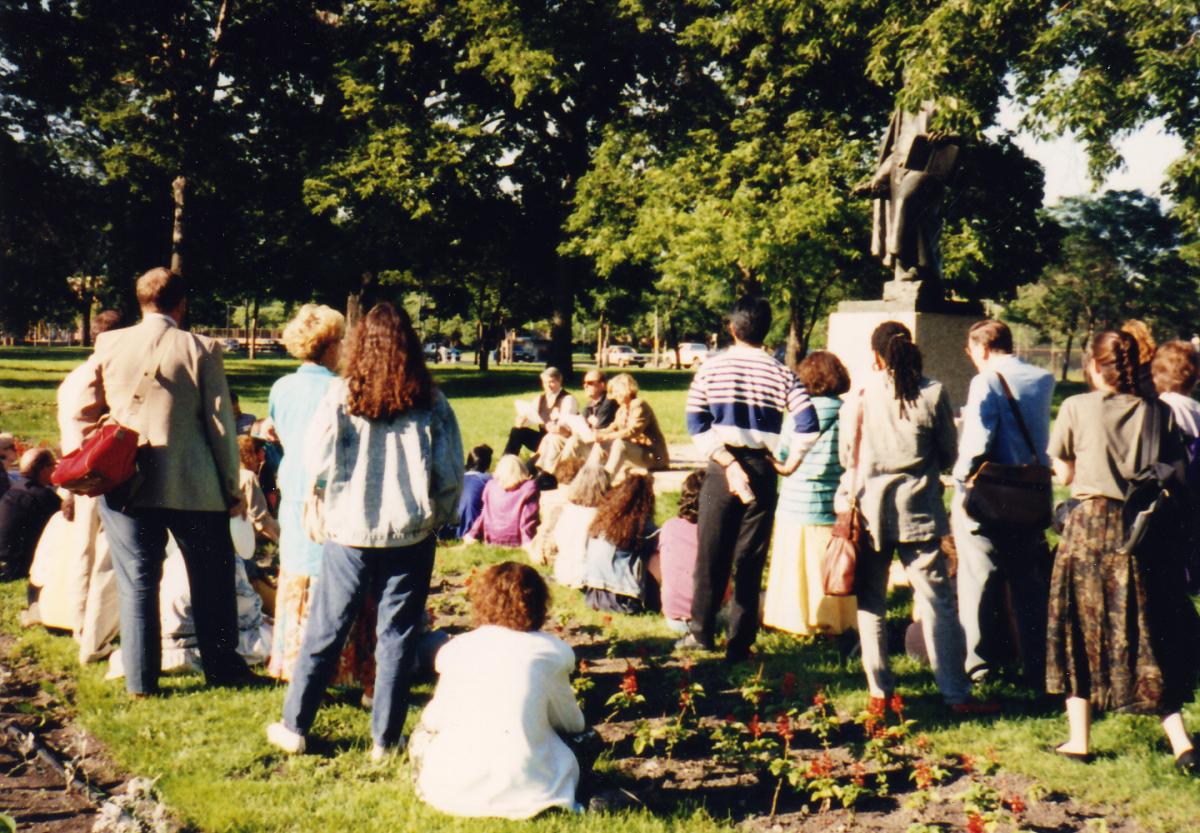
And, yes, they really did have a picnic at the foot of the Lessing statue in Hyde Park, Chicago.
Notable Achievements
Among LMDA‘s notable achievements over the past 25 years are these services to the profession.
The LMDA Review, currently an online, peer reviewed journal serving as the organization‘s voice of dramaturgy and, under the editorship of D. J. Hopkins, in the process of achieving MLA accreditation. Generations of editorial and other leadership include Rick Davis, Steven Hart, Carey Perloff, Anne Cattaneo, Geoff Proehl, and Shelley Orr.
The LMDA Script Exchange, founded by Lynn M. Thomson and Anne Cattaneo to establish national networking about new plays and to build a community of new play dramaturgs; in its first eight years alone, the Script Exchange published 35 issues that included reviews of more than 1,000 new plays.
LMDA’s Advocacy Caucus, founded in 1996 by Lynn M. Thomson, which provided the first guidelines for employment of freelance dramaturgs based on member surveys conducted by the Caucus (with Lynn Thomson and Shirley Fishman at the helm) and ultimately generated the current LMDA Employment Guidelines.
The “virtual” presence of LMDA, which began with an electronic bulletin board system generated by Richard Finkelstein, then developed into the U Caucus Discussion List (1994), became affiliated for many years with the Dramaturgy Northwest website under the guidance of Geoff Proehl with support from the University of Puget Sound, and now includes the official LMDA website. The LMDA website is rich with national and international resources, and the organization also operates through our social networking presence on Facebook. Finally, the LMDA listserv, open to members and nonmembers, provides a forum for those seeking information about plays, production dramaturgy, current issues and events, and a myriad of other discussion points and debates pertaining to professional theatre — from local to international. It serves the needs of a diverse population of theatre practitioners and teachers.
Member-authored (and often LMDA> incubated) dramaturgy publications that both report and drive the profession, including the LMDA Source Book, Volume I (edited by Susan Jonas, for teachers), the Source Book, Volume II (Susan Jonas and Lee Devin); Mark Bly‘s seminal The Production Notebooks (Volume 1, 1997, Volume 2, 2001); the LMDA Bibliography, the Guide to Dramaturgy Training Programs, and Guide to Internships; Dramaturgy in American Theatre (Jonas, Lupu and Proehl, 1997); Between the Lines: the Process of Dramaturgy(Judith Rudakoff and Lynn Thomson, 2002); the Twentieth Anniversary Book (interviews with LMDA‘s past leaders by Shelley Orr and Liz Engelman, 2004); International Resources (edited by Vanessa Porteous and Madeleine Oldham); Internship Guidelines (edited by Brian Quirt and Carrie Hughes); Artful Making (Lee Devin and Robert Austin, 2003; Elliott Hayes winner, 2005); numerous articles by Paul Walsh, Michael Bigelow Dixon, Mark Bly, and DD Kugler; and most recently Geoff Proehl‘s Toward a DramaturgicalSensibility: Landscape and Journey (winner of ATHE‘s 2009 Outstanding Book on Theatre Award) and The Process of Dramaturgy: A Handbook by Julie Felise Dubiner, Scott R. Irelan and Anne Fletcher (2010).
Since 1991, a system of regional vice-presidents, who maintain a yearlong presence around the Americas and stage mini-conferences and other events for the dramaturgical and literary management communities—as well as promoting regional theatre venues and a healthy regional ecology. (See our website for the regions, which also provide lists of members in each.)
The successful Dramaturg-Driven Projects initiative Residency Grants, and Early Career Dramaturgs fund raisers, through which LMDA members and officers have raised funds to support the temporary hiring of dramaturgs at venues without staff literary support (sometimes leading to long-term employment); have awarded grants to dramaturg-driven projects in theatre, dance, and opera; have brought emerging dramaturgs to conferences by assisting with travel funds; and have provided a first year‘s free membership for ATHE‘s Dramaturgy Debut Panel winners and for the Kennedy Center American College Theater Festival‘s eight yearly dramaturgy competition regional winners. These programs have been driven by members Maxine Kern with the assistance of Susan Jonas (residencies); Kelly Miller, Madeleine Oldham, and currently Julie Felise Dubiner (ECDs funding); and D.J. Hopkins, Liz Engelman, Brian Quirt, Shelley Orr, Cindy SoRelle, Megan Monaghan, and Gregg Henry (ATHE/KCACTF initiatives).
Beginning in 2004, LMDA leaders Liz Engelman, Mark Bly, and Brian Quirt first generated an international dialoguewith playwrights and literary managers in Mexico, the UK (Dramaturgs‘ Network), and Europe—connections that have brought a host of visiting theatre practitioners to LMDA conferences and have generated current and potential collaborations as well as the international resources project noted above. The UK dramaturgs‘ network has studied our model. The Toronto, Minneapolis, and San Diego conferences provided for our international colleagues—playwrights and dramaturgs — a forum for presenting their work.
In 1999, through the labor of Michael Bigelow Dixon and Amy Wegner, LMDA established the Elliott Hayes Award, to be given annually for outstanding dramaturgy in the Americas. The award is named for the late Elliott Hayes, longtime literary manager and dramaturge for the Stratford Festival, who lost his life prematurely in an automobile accident. Its first recipients were Michele Volansky (Steppenwolf Theatre Company) and Lue Morgan Douthit (Oregon Shakespeare Festival). Subsequent Hayes award honorees include Rebecca Rugg, Lynne M. Thomson, Judith Rudakoff, Megan Monaghan, Freddie Ashley, Brian Quirt (2), Mallory Catlett, Scott Horstein, Lee Devin, Melinda Finberg, Amy Steele, Ed Sobel, and Ilana Brownstein. It was awarded to Robyn Quick at the 25th Anniversary Conference banquet.
Finally, LMDA‘s Gotthold Ephraim Lessing Award, our most prestigious tribute, given for a lifetime of achievement, has been conferred upon Anne Cattaneo (1998), Arthur Ballet (2002), and Michael Lupu (2006). This award was again presented to Mark Bly during our 25th anniversary conference.
¿QUIENES SOMOS?
Asesores Literarios y Dramaturgistas de las Américas (LMDA por sus cifras en Inglés) es una organización sin fines de lucro con miembros en Canadá, Estados Unidos, México y el resto del mundo.
LMDA fue fundada en 1985 como una organización voluntaria para afianzar las profesiones de Asesores Literarios y Dramaturgistas.
LMDA cree fielmente que el teatro es una forma de arte vital, con el poder de nutrir, educar y transformar individuos y sus comunidades; y que el dramaturgismo es central en el proceso de creación de teatro.
LMDA está comprometida con los siguientes objetivos:
Afirmar, validar y extender los roles que los Asesores Literarios y Dramaturgistas juegan en el proceso de creación de teatro.
Promover el intercambio de información acerca de las funciones, práctica y valor de Asesores Literarios y Dramaturgistas.
Alentar la cooperación entre los practicantes y teóricos en el campo del Dramaturgismo
Ampliar los límites del campo y enriquecer la conversación acerca de la creación de interpretaciones en vivo, así como acoger a nuestros colegas de disciplinas como danza, ópera y arte corporal.
Enfatizar intercambios internacionales y fortalecer nuestro compromiso con la diversidad de cultura, forma y contenido.
Alentar el teatro como actividad regional en Canadá, Estados Unidos y México.
JEDIL/T Statement
LMDA promueve la creación de historias que reflejen una amplia gama de expresiones auténticas en el panorama global. Somos partidarios de equidad, diversidad e inclusión como parte fundamental de nuestros valores. Reconocemos y examinamos la interseccionalidad de nuestra sociedad. Estamos comprometidos a abordar, defender y provocar el derecho a la justicia, la equidad, la diversidad, la inclusión y la reconciliación territorial. El trabajo de nuestros miembros fomenta un ambiente de respeto, celebra nuestras diferencias y hace valer los principios de LMDA en cada aspecto de la organización.
Considera unirte a LMDA y suma tu voz a la conversación.
[Traducido por//Translated by Brenda Muñoz]
Nuestra Historia
1984
Nos encontramos en el mes de Enero del año 1984. Apple lanza su producto Macintosh, el ordenador portátil. Luego, en Octubre, se anuncia el premio Nobel de la Paz otorgado a Desmond Tutu. Al llegar Noviembre, el grupo musical “Band-Aid” graba su primer éxito benéfico. En Diciembre, Cynthia Jenner, Alexis Greene, y Thomas Dunn en una carta a Jerome Foundation, establecieron una infraestructura para formalizar una organización teatral sin ánimo de lucro. Con el apoyo de varios colegas concibieron un formato recursivo para Dramaturgistas y Asesores Literarios. Este programa, lanzado poco después, incluiría en su misión publicar trimestralmente un boletín informativo, proveer un banco digital de datos (incluyendo una fuente bibliográfica y una lista de especializaciones académicas y cursos de estudio sobre el tema), establecer un programa de pasantía y crear un comité para empezar a organizar conferencias. Previo a la generación y entrega de dicho documento, y como bien lo ha indicado expresidente de LMDA David Copelin, “dramaturgistas en la región de Nueva York, Nueva Jersey y Connecticut se reunían informalmente una vez al mes, usualmente para almorzar… a menudo se discutía (con anhelo) la creación a nivel nacional de una organización formal de dramaturgistas”.
1985
La organización New Dramatists ubicada en Nueva York generosamente donó el uso de sus instalaciones y un espacio para oficinas. El 26 de Marzo de 1985, Literary Managers and Dramaturgs of America (LMDA) se estableció con Thomas G. Dunn, Susan Gregg como directores y Bonnie Marranca oficialmente al mando. En Noviembre, con el patrocinio de Arthur Foundation y con la ayuda de los colaboradores de Hunter College, se organizó una conferencia nacional. Des Mcanuff dio el discurso de apertura que fue publicado en American Theatre, lo que luego se convertiría en el Boletín LMDA (1.1, enero, 1986).
1986
En agosto de 1986, se llevó a cabo la primera conferencia “anual y oficial” de LMDA en las instalaciones de New Dramatists, una organización que continuaría siendo un respaldo fiel. Ese año la segunda edición de Yale Theatre, dedicado a la dramaturgia, fue editado por el miembro Mark Bly. (El primero fue editado por Joel Schechter en 1978).
1988
En 1988, Michael Devine y DD Kugler se volvieron los primeros miembros Canadienses de LMDA. Kugler, a futuro, se convertiría en el primer directivo Canadiense (Vicepresidente de Canadá, Vicepresidente de Comunicaciones y más adelante Presidente de LMDA). LMDA Canadá (fundada en 1997), bajo el extenso liderazgo de Brian Quirt (luego Presidente de LMDA) y Vicki Stroich (Presidente de la Conferencia 2010), ha logrado consolidarse como comunidad integral en Canadá y una parte esencial de LMDA.
En los últimos años de la década de los 80, LMDA fue alimentada por la pasión de profesionales que trabajaron colectivamente para fortalecer la organización fungiendo como líderes institucionales y anfitriones de las conferencias; entre ellos Alexis Greene, Cynthia Jenner, David Copelin, Rick Davis, Steven Hart, Lynn M. Thomson, Mark Bly, Morgan Jenness, Susan Jonas, y más.
La tercer conferencia anual se llevó a cabo en Junio de 1988 y se tituló “Dramaturgismo y el Proceso Creativo”. La conferencia tuvo lugar en O’Neill Theater Center en Waterford, Connecticut. Joe Chaikin ofreció una lectura de su obra Struck Dumb, escrita conjuntamente con Jean-Claude van Itallie y comisionada por Mark Taper Forum. En esta conferencia, James Leverett recibió un premio por “Excelencia en Dramaturgismo”. Aquí una cita de Leverett escrita a mediados de los años 80 en un artículo titulado “Después de la Revolución”.
“Cada vez menos, el teatro puede darse el lujo de tener semblanza alguna con el cine y la televisión, aunque siempre puede hacer uso creativo de ellos, junto con todo lo demás que el mundo tiene para ofrecer. El teatro, en cambio, debe reflejarse exactamente como lo que es: un espacio finito para la imaginación infinita.”
El año siguiente, por primera vez, LMDA designó a la Costa Oeste como sede de la Conferencia Anual. Ésta se llevó a cabo en San Francisco State University con Anne Bogart como oradora principal, quien habló sobre los enlaces entre el teatro, el cine y la televisión.
1990
Los años 90 trajeron con ellos un ímpetu de actividad para LMDA, con Anne Cattaneo, Victoria Abrash, Mark Bly, Jim Lewis y otros profesionales en puestos de liderazgo. En el verano de 1990 Richard Pettengill presidió una conferencia en DePaul University en Chicago. En dicha conferencia el nombre de la organización cambió oficialmente a Literary Managers and Dramaturgs of the Americas para reconocer el crecimiento de LMDA y acoger a miembros de todo el continente Americano. El cambio de nombre fue aprobado por los miembros en la quinta Conferencia Anual en Chicago, durante Junta Anual General (Annual General Meeting) e incorporado a los estatutos en 1991.
LMDA estableció una nueva línea de trabajo y contrató a Chiori Miyagawa como administrador, el primero de una fila de individuos sobresalientes que fungirían como administradores en el futuro para asistir con MEMBERSHIPS, conferencias y publicaciones. ¡Bravo!
Y es cierto, en esa conferencia los miembros de LMDA tuvieron un picnic en Hyde Park, Chicago, al pie de la estatua de Gotthold Ephraim Lessing – escritor, dramaturgo, filósofo, poeta y crítico del arte alemán, considerado padre del Dramaturgismo.
[Traducido por//Translated by Daniela Atiencia & Brenda Muñoz]
Logros Destacados
LMDA ha tenido varios logros destacados en los últimos 25 años en el servicio de esta profesión. Entre ellos se encuentran:
El LMDA Review, una publicación periódica en línea que sirve como la voz de la organización acerca del dramatismo. Bajo el liderazgo editorial de D. J. Hopkins, está en el proceso de recibir la acreditación MLA. Líderes de la organización incluyen a Rick Davis, Steven Hart, Carey Perloff, Anne Cattaneo, Geoff Proehl, and Shelley Orr.
EL LMDA Script Exchange, que fue fundado por Lynn M. Thomson y Anne Cattaneo para establecer una red nacional sobre obras nuevas y fomentar una comunidad de dramaturgistas especializados en ellas. En sus primeros ocho años, el LMDA Script Exchange publicó 35 volúmenes que incluyen reseñas de más de 1000 obras nuevas.
El LMDA’s Advocacy Caucus, fundado en 1996 por Lynn M. Thomson, estableció la primera guía para el empleo de dramaturgistas independientes basada en encuestas de miembros. Este esfuerzo culminó en la actual Guía de Empleo de LMDA (LMDA Employment Guidelines).
La presencia virtual del LMDA inició como un boletín electrónico creado por Richard Finkelstein que después evolucionó al U Caucus Discussion List (1994). Estuvo afiliado por muchos años con el sitio web “Dramaturgy Northwest” bajo la tutela de Geoff Proehl y el soporte de la Universidad del Puget Sound. Hoy, esta presencia virtual, incluye:
El sitio oficial de LMDA, que provee una gran variedad de recursos nacionales e internacionales.
Redes Sociales, incluyendo la operación de la página oficial de LMDA en Facebook.
LMDA Listserv, que provee un foro de discusión de nuevas obras, dramatismo de producción, eventos, y otros temas relevantes a la profesión.
Publicaciones de Dramaturgismo Escritas por Miembros que reportan y esculpen el futuro de la profesión. Entre ellas están el LMDA Source Book Volumen I (ed. Jones), el LMDA Source Book, Volumen II (ed. Jones y Devin), The Production Notebooks (Bly), LMDA Bibliography, la Guía de Programas de Entrenamiento de Dramaturgismo, la Guía de Becarios (ed. Quirt y Hughes), Dramaturgy in American Theatre (Jonas, Lupu and Proehl), Between the Lines: the Process of Dramaturgy (Rudakoff y Thomson), the Twentieth Anniversary Book, International Resources (ed. Porteous y Oldham), Artful Making (Devin y Austin), varios artículos escritos por Paul Walsh, Michael Bigelow Dixon, Mark Bly, y DD Kugler. Publicaciones recientes incluyen: Toward a Dramaturgical Sensibility (Proehl), Landscape and Journey y The Process of Dramaturgy: A Handbook (Dubiner, Irelan y Fletcher).
Establecido en 1991, un sistema de vicepresidentes regionales, quienes mantienen una presencia permanente en diferentes regiones de América, organizando mini-conferencias y otros eventos para las comunidades de Dramaturgistas y Asesores Literarios – así como promover teatros regionales y un ecosistema teatral saludable. (Nuestro sitio web tiene una lista de todas las regiones y de sus miembros).
La exitosa recaudación de fondos para la Iniciativa de Subvención para Proyectos Liderados por Dramaturgistas y para el programa de Dramaturgistas en Inicio de Carrera (ECD por sus cifras en inglés). Estos programas dan un estipendio para la contratación temporal de dramaturgistas en teatros sin personal literario, subvencionan proyectos de dramaturgismo teatral, de danza y ópera, asisten a dramaturgistas en incio de carrera con fondos para viajes y registro de conferencias. Estos programas han sido liderados por miembros de LMDA como Maxine Kern (con la asistencia de Susan Jonas), Kelly Miller, Madeleine Oldham, y actualmente por Julie Felise Dubiner (con fondos de ECD) y por D.J. Hopkins, Liz Engelman, Brian Quirt, Shelley Orr, Cindy SoRelle, Megan Monaghan, y Gregg Henry (Iniciativas ATHE/KCACTF).
Comenzando en el 2004, líderes de LMDA, Liz Engelman, Mark Bly, y Brian Quirt, generaron un diálogo internacional con dramaturgistas y asesres literarios en México, el Reino Unido (Dramaturgs‘ Network), y Europa. Estas relaciones han fomentado la participación en las conferencias de LMDA de varios practicantes de teatro internacionales y han generado varias colaboraciones. La red de dramaturgistas del Reino Unido, Dramaturgs‘ Network, ha estudiado este modelo. Internacionalmente, las conferencias de LMDA en Toronto, Minneapolis, y San Diego proveyeron un foro para presentar el trabajo de nuestros colegas internacionales.
En 1999, gracias al esfuerzo de Michael Bigelow Dixon y Amy Wegner, LMDA estableció el Premio Elliott Hayes, el cual se otorga anualmente a una persona por Desempeño Sobresaliente en Dramaturgismo. El nombre del premio es en memoria de Elliot Hayes, asesor literario y dramaturgista del festival de teatro de Stratford que perdió la vida en un accidente automovilístico. Los primeros dramaturgistas galardonados con el premio fueron Michele Volansky (Steppenwolf Theatre Company) y Lue Morgan Douthit (Oregon Shakespeare Festival). Ganadores subsecuentes incluyen a Rebecca Rugg, Lynne M. Thomson, Judith Rudakoff, Megan Monaghan, Freddie Ashley, Brian Quirt (2), Mallory Catlett, Scott Horstein, Lee Devin, Melinda Finberg, Amy Steele, Ed Sobel, e Ilana Brownstein. Robyn Quick recibió el premio en el banquete del Vigesimoquinto Aniversario de LMDA.
Finalmente el prestigioso Premio Gotthold Ephraim Lessing, otorgado por logros vitalicios destacados en el campo del dramaturgismo, ha sido otorgado a Anne Cattaneo (1998), Arthur Ballet (2002), y Michael Lupu (2006). Mark Bly recibió el premio en el banquete del Vigesimoquinto Aniversario de LMDA.
[Traducido por//Translated by Mario Gómez]
User Login
Remember to log-in so that your Member Benefits appear on this site.