The Folklore Project
by Abigail Dillard, MFA
What folktale should be told in the world today?
When asked if I would like to create a devised theater piece, which would also be my directorial debut at the University of North Alabama, I was thrilled at the opportunity. I knew that there would be many challenges ahead. First, I would have to define what “devised theater” is. I was in a new city, a new state, and working within a new theater department that also has a concentration in film. This new universe was more exciting than daunting. Yet, I knew I needed to learn more about my new environs, first and foremost.
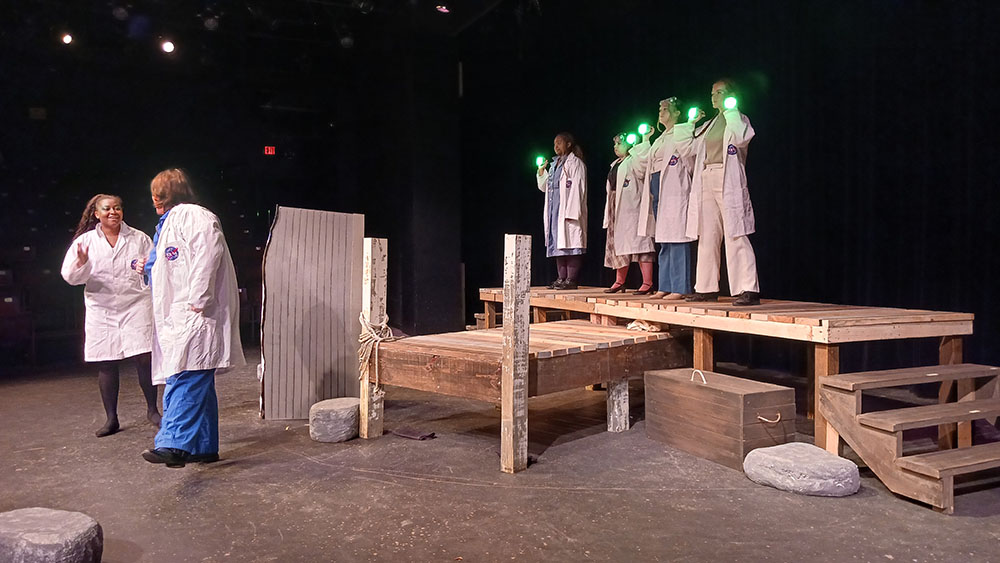
When I arrived in Florence, Alabama and started to explain the project, the local residents were quick to share their version of the history Florence. They asked if I knew of the history of the buildings downtown, the bridge crossing to Muscle Shoals, the prominent music scene, the Native American mounds, the legacy of Trail of Tears, the bandits who had run through the area, Helen Keller’s birthplace. They spoke of their personal family connections to Florence and the ghosts that still haunt them. Faced with much dramaturgical material, the question wasn’t what kind of story we should tell but which one. I was inspired to create The Folklore Project.
The performers and creative team agreed to try their hand at devised theater even though they were unfamiliar with the process. I explained original projects are often prompted with a “burning question;” one that is open-ended but can lead to multiple avenues of research. I asked, “What folklore would you like to see in the world today?” The team then began their research. We met with the campus historian, who gave us a historic tour of downtown Florence. We asked about the buildings, the families who built them and soon learned of the many legacies left behind. We attended a ghost walk hosted by the University, where we learned about Florence’s involvement in the Civil War. We learned of the men and women who died building the campus and their spirits that continue to haunt. Some students travelled to nearby Huntsville, where one had family ties to the U.S. Space and Rocket Center. Others researched a playground placed within a local cemetery and learned of stories of children who had been buried there.
We brought all of information into the rehearsal space and worked to have each member of the seven-member ensemble create their own story. We drew upon different exercises crafted by companies such as Frantic Assembly Company and SITI Company. We played improvisational games and created dynamic stage pictures.
Once we had the scenes outlined, we met with our designers and began to create seven distinct stories.
There were several hurdles we had to overcome. The most challenging being a five-week rehearsal period. Script development is something in which I have the least amount of training. I typically rely on movement practices or musical accompaniment in place of text to develop a story. Our first round of audience feedback revealed that we were missing key components in the script; namely, transitions from one idea to another.
Following through on our devised theater process we went into full performances, which gave the students an idea of how to survey the audience. We placed QR codes in the lobby for audience members to fill out and continued to ask those open-ended questions about plot and individual stories to strengthen the production.
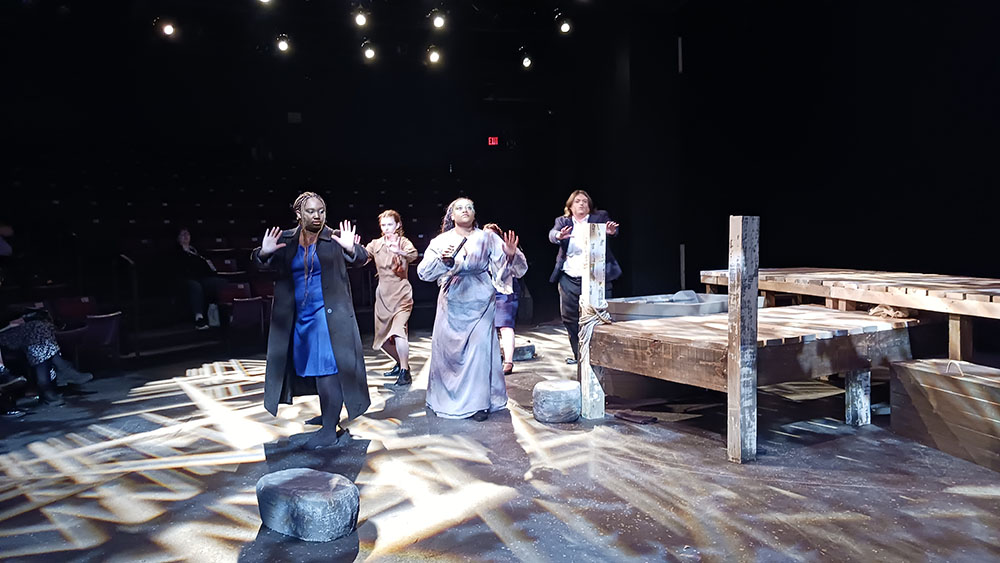
The creative team crafted a folktale that incorporated seven stories inspired by local North Alabama folklore. We chose to follow the character of Elsie, who traveled through time in search of her sister. Elsie’s sister has been kidnapped by Tom Clark, a carpetbagger and the villain, whose was known for having plundered and murdered throughout the Florence area after the Civil War for his own personal gain. We then meet Annie, a young woman in search of love and family, which she finds in the Rogers Department Store, a local business founded in 1894 in Florence. Next, we meet Chuck, a NASA engineer, who works on the Apollo program and Saturn V Rocket at the nearby Huntsville Space Center. Marcus, who suffers many hardships and chooses to run away from his problems down the Tennessee River, where he meets his demise. Young Sylvie, a ghost child, is suspected of having spread influenza through the area for the first time. Julianna, is a young rebellious girl who fights for women’s rights. And finally, Florence, a young woman who dreams of closing the divide of the river that separates her two communities of Florence and Muscle Shoals. We took our audience on a journey through time and space sharing universal lessons about the strength and formation of community and the power of storytelling.
Our audience was highly receptive to the work. We found that many people connected to one or more of the folktales and had no idea they were watching a devised theater piece. From their constructive feedback we went back to work.
We learned that the show met the qualifications for the Southeastern Theater Conference’s Fringe Festival. We applied and were accepted. We had only eight days to rework and remount. I had now been working with the students for six months and a common language had developed among us. During this time, I was also teaching acting classes, one voice and one movement course.
My team and I knew that the stories had an impact due to the feedback we received. We also knew that the script had some weak spots. We were concerned about facing a new audience with no knowledge of North Alabamian folklore. We eventually cut 12 pages from a script that had originally been 40. We added more movement, which allowed the characters to embody the flowing spirits of the Tennessee River that was at the heart of the show.
The Folklore Project is a devised theater piece that embraces the power of writing your own story. Elsie taught us that we should always fight to write our end of the story. Annie taught us the importance of leaving a legacy. Chuck showed that you can reach for the stars. Sylvie taught us the importance of community. Julianna showed us that girls can do anything. Florence showed us the power in making brave decisions. The impetus for this project was to expose students to a new way of creating theater and to highlight the strength of community building.
Abigail Dillard, MFA
Visiting Assistant Professor of Theater
University of North Alabama
Cinematic Arts and Theater Department
Land Acknowledgement: We acknowledge that the University of North Alabama is situated upon the traditional homelands of Tsalaguwetiyi (Cherokee, East) and Chikashsha Yaki (Chickasaw) tribal nations. We respect and honor the land itself and the people who have stewarded it throughout generations. We pay homage with gratitude to the many diverse Indigenous peoples still connected to this land on which we gather.