
A Dramaturgy of Community, Change, and Commitment: Sanaz Toossi’s Wish You Were Here
by Suzi Elnaggar
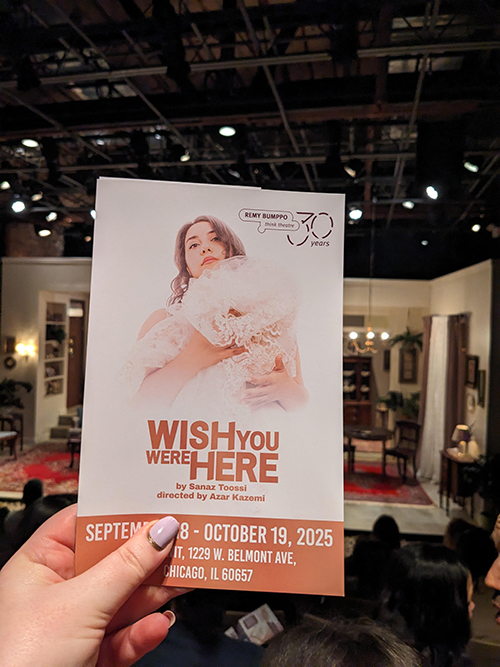 On October 18, an estimated 5 million or more people across the United States gathered in all 50 states throughout the morning and afternoon, taking tentative steps toward mobilizations, first steps of commitment. Later that evening, a fellow dramaturg, Maren Robinson, the Chicago LMDA VP, met up with me to see the Chicago premiere of Sanaz Toossi’s Wish You Were Here at the Remy Bumppo Theatre, directed by Azar Kazemi and dramaturged by Jacob C. Shuler. The run closed the very next day, and we were able to snag some last-minute tickets for the Saturday evening show. So, tired and bedraggled, we sat down for theatre.
If you haven’t come across Toosi’s work, she is well-known for her 2023 Pulitzer Prize-winning play English, about four Iranian students learning English and exploring the relationship between language and identity, which was recently on Broadway. In Wish You Were Here, Toosi introduces us to a group of friends in Iran in 1978, as they help prep for a wedding. We are dropped into their world, the wedding dress already on the bride, as they pamper and preen: the Jewish girl who is the life of the party; her acerbic, cool Muslim bestie; the religious bride who is the soul of kindness and friendship; the annoying hanger-on who still hasn’t grown up and doesn’t realize it; and the scholar dreaming of leaving for somewhere else. The play jaunts across time but stays in the living rooms and parlors of their small Iranian town, as the group dissolves and reassembles in different formations. We know the history happening outside the walls, but it never quite invades that space. Instead, that living history changes these friends, removes them, exiles them, and forges them into something and someone they never expected to be.
After the play ended and we had exited to the lobby, we had almost nothing to say. Was it too on-the-nose to see a narrative of the ripples of political upheaval on that day? Was it too on-the-nose to say anything at all? It was late and raining outside. We chatted for a bit, said “hi” to the cast and creatives, separated, and went our ways, heading home.
We are in a moment, as humans, citizens, and artists, when the pace of change has become more and more frantic. The last five years have felt like the whirla-gig at the county fair, the one that sticks you to the walls, leaves you hanging upside down, desperately trying to right yourself so you don’t land on your head when it stops. Wish You Were Here is built around a dramaturgy of change and community, where it stays in the parlor and living room while the world shifts around the characters in uncontrollable ways, sweeping them in and out of the narrative and that parlor. It isn’t the protest, and it isn’t the marches. It’s the community, that group of friends or colleagues, that moment of joy that feels like it will stretch to infinity.
As dramaturgs, we are often called to be the questioner, the noticer, the cohesion-giver. We, like the characters of Toosi’s play, sometimes struggle to bring the disparate ideas, moments, and things together, to find what has been lost, to keep making and creating while the world shifts. We are here, in this moment, in community in small rooms across the Americas, in rehearsals and production meetings, in offices and on zoom. We are also constantly reaching across space to find community with each other in our far-flung locations.
Toosi’s Wish You Were Here embraces both a dramaturgy of community and change, and how, no matter how much we stay in the room, the world outside continues to spin. People march, and time marches, and neither can be stopped. Like those women in 1978, we don’t know what comes next. We don’t know what changes. But we can keep building community, both inside and outside of the rooms we occupy.
For Egyptian and Arab artists, there is the concept of commitment, which expands and draws on Sartre’s notions of engagement. Across decades of change and geographies, these writers and artists grappled with what it meant to consciously be in community as an artist. What it meant to effect change, to be ethical, and committed to those around you. As dramaturgs, we are sometimes the Jiminy Cricket, the small voice, the guiding light in the rooms we occupy. I believe that many of us are drawn to dramaturgy, not just because we are smart (we are!) or linguistically or narratively minded (again, dramaturgs have some of the most brilliant minds), but because we feel that pull of commitment to our communities. To make sure the play or the playwright's voice is heard and uplifted, to be bold when needed, and circumspect at other times. To ask the hard question or point out the elephant that everyone in the room is dancing around. Like those writers across Lebanon, Syria, Iraq, Egypt, and Jordan, and the other parts of North Africa and Southwest Asia did in the last century, we must wrestle with what it means to be a conscious artist amidst change, as the world swiftly tilts and whirls around us, just outside our rooms.
The dramaturg’s material for the Chicago production starts with these words from the playwright:
"For Iranian women.
May you be brash, tender,
obnoxious, fragile, inappropriate,
and know that the world
will be worthy of you one day."
As Toosi’s Wish You Were Here shows, we can continue to reach out to each other. But I believe it is necessary for us to acknowledge actively what happens outside our artistic spaces. As we flow from one year into the next, I hope dramaturgs can be a community of commitment, no matter what changes come. I hope we also can be brash and tender and worthy of those around us, while helping together, in many rooms, to build a more humane, more dramaturgical world for each other.
You can read more about this production of Wish You Were Here and see some production photos: https://www.remybumppo.org/shows/wywh/
Dramaturg’s materials are found here: https://sites.google.com/view/wywhaudiencenotes
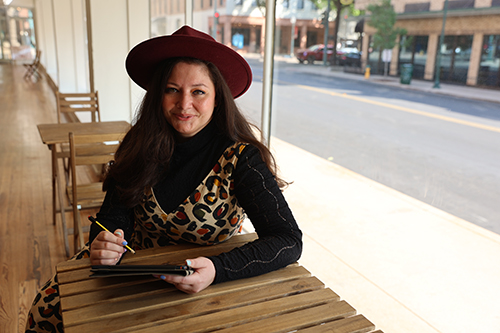 Suzi Elnaggar is an Egyptian American performance scholar, freelance dramaturg, and theatre maker. She was a 2021 Kennedy Center Dramaturgy Intensive Fellow and works as a developmental and community-focused dramaturg. Her work has been published in Asian Theatre Journal, Arab Stages, Review: The Journal of Dramaturgy, and Theatre Times. Her interests include exploring postcolonial theatre contexts, decoloniality in performance, the intersection of trauma and performance, transnational and migrant stories, recontextualizing Greek tragedy, myths, and folklore, and exploring work that centers around SWANA (Southwest Asian and North African) experiences. Suzi’s scholarship and practice center community, collaboration, and context.
As a dramaturg, she is experienced in both production and developmental work. She is the artistic director of Backstitch Story Project, and the founder and creative director of the Digital Development Project. She has read scripts for PlayPenn, Playwright’s Center, Rattlestick’s Van Lier New Voices Fellowship, SHE-LA, and Sparkfest, among many others. Selected dramaturgy credits (Production & Developmental Workshops): Avalanche Theatre’s Next Draft The Sex Talk I Never Had and Grape Leaves, Silk Road’s Shahadat; Backstitch Story Arts Off-White: The Arab House Party Play; Clamour Theatre’s Lived Experience; TACTICS Ottawa’s ANANSI V. GOD(S); Jubilee Theatre Waco’s Fairview (Texas Premiere); Wild Imaginings’ Jesus and Valium (World Premiere), The Way He Looks at You, Cardboard Castles Hung on Walls (World Premiere); Northwestern University Theatre’s The Great Sea Serpent (Workshop Premiere).